Here is a 3 inch jeweler's saw that gets high marks on Amazon. These are great for cutting intricate shapes in thin sheet metals such as gold, silver, copper, and brass. The saw comes with a pack of 144 saw blades in assorted sizes (fineness of cut). If you are just getting started with one of these, you'll want two things to go with it. First, you will want a decent bench pin to use as a sawing platform. I use a wood bench pin with a metal anvil. This saves you from shifting back and forth between tools quite so often. Finally, you will want some Cut Lube or beeswax with which to lubricate the back side of the saw blade.
You recall Rob Higgs -- the artist who created the giant wine bottle opener? Here is his latest, a large human figure with moving hands, head, eyes, and many other elements. It's a wonderful assemblage of parts. I can even spot one near to my heart and very near to the automaton's: a lyre-framed brass clock movement with its large spiral mainsprings. The video description notes that he forgot to wind clock mechanism that runs the "brain", and indeed, if you look closely you can see the winding key sticking out the back of the figure's head. It's truly incredible piece. I would expect no less from this particular artist.
Here's artist Tom Harold's second instructional video on how to make welded rolling ball track sculptures. This video covers the basics of welding a T-joint, a commonly used joint in rolling ball sculptures. In the video, Tom shows the proper way to prep parts, tack weld, weld with filler rod, and the details of a track clamp -- one of the special tools he uses in making ball tracks.
GJ Pearson created this fascinating kinetic sculpture titled Tiny Grass Is Dreaming. Similar to a weight-driven clock, a crank is turned to raise a weight, which in turn powers an escapement. The escapement allows the power to released in small stages. Also like a clock, the mechanism causes a bell to strike periodically. The wire construction is both impressive and beautiful. This piece took great skill to create, I am sure.
The sound of the ball on the track immediately satisfied me that there is friction in this system and thus cannot run indefinitely. Still, it appears to be remarkably efficient and the ingenuity is undeniable. The combination of a metal ball, magnets, a gimbaled rack and multiple pendulums is not something I've ever seen before.
This book gets some great reviews on Amazon. I'm going to add it to my wishlist.
From the book description:
For the first time, a book has been written that explains all the tools and techniques necessary for successfully building models with brass. The detailed text is illustrated with over 320 color photos. Whether substituting for an existing plastic model kit part or assembly, making a master pattern for casting, or creating a complete scratch-built model, the range of brass fabrication methods and tools used are explained. Readers are exposed to every technique for cutting, forming, fabricating, soldering, and final finishing of commercially available brass stock. Specific chapters focus on the use of various tabletop machines and chemicals to assist readers in the creation of very detailed brass models.
Artist Aaron Kramer knows how to make things. He also knows how to use a huge assortment of materials. When asked about making cold connections with wire, he decided to produce this very instructive long-form video (about 10 minutes) on the topic.
From the artist:
I really haven't seen anything worthwhile on the internet so here is my take on the subject. I put together this little 9.5 minute introduction with a running commentary to impart a little of what I know. I feel a trained jeweler or metalsmith may have a different take on this so this is what you get from a self taught artist type.
I've been doing a bit of posting about practical matters in the world of clock repair on my other site clockfix.com. In one of my recent blog posts there, I documented how to make a very small steel machine screw for a French clock I was working on. Here's the result:
A colleague who has far more experience in this field made two good suggestions. The first was to anneal the metal before turning it down and threading it. This will make the dies last a lot longer. The second, was to part the piece using a jeweler's saw rather than a file. The blades are cheap, and the file will last a lot longer too. He then hardens, tempers, and finishes the screw as the final steps. Good advice; all of that makes perfect sense.
Artist Aaron Kramer created this wonderful kinetic sculpture of a boxer in motion. As is his custom, he started with a mechanism and no real plan. Working with metal, and joining it by welding allowed him to change and adapt the design on the fly. Here is a 19 minute video which documents the entire fascinating process. He has provided a running caption below the image providing insights into his thoughts and process.
From the artist:
I have always liked when others produce “process” videos. It gives me an insight into their brains that the finished piece doesn’t always reveal. Making things move is not a straight-line process. It involves putting together and taking apart a million times before you get it right. I like to see that messiness. It makes me feel human. In my case it took several thousand cranks and a whole lot of welds in order to breathe life into my little figure.
The latest installment of my articles on automaton making is now available on the Cabaret Mechanical Theatre web site. In this one, we look at some different ways to cut brass rod, wire, tubing, and sheet. We use various tools including cutting pliers, hacksaws, tubing cutters, hobby saws, and the jeweler's saw.
Check out this beautiful short video profile of artist Anthony Howe. Formerly a painter, Howe has turned his considerable artistic skill toward making large kinetic sculptures powered by the wind. They are at once somewhat alien and strangely familiar -- like jellyfish from outer space cast in metal.
The folks over at the amazing Atlas Obscura blog did a great round-up of animal themed automata the other day. Among them was this life size peacock automaton created in 1777 by James Cox. The automaton is The State Hermitage Museum, Saint Petersburg, Russia.
From the video description:
Peacock clock at the State Hermitage Museum in Russia. Made in the 18th century by James Cox, an English clock maker, and sold to Potemkin (a favorite of the Catherine the Great) as spare parts. It took 9 years for a Russian mechanic named Ivan Kulibin to put it together again. Well worth it. It is run only once a year during June to preserve the mechanism, so you have very few chance to see it work. Made of gilded bronze silver and glass, it measures 3 meters in height. The dial of the clock is embedded into the head of a mushroom with a dragonfly moving on top to indicate the time.
Check out this wonderful film which profiles automaton sculptor Jacques Monestier. I'm sorry I can't say more about it; my French just isn't that good. Trust me, you will enjoy the film! His demonstration with the mechanical hand is truly amazing.
With close to six million views on YouTube, this video doesn't fall into the "undiscovered" category. Nevertheless, it falls into the crazy-amazing-miniature-machine category.
This incredibly small motor is the work of a Spanish engineer named Patelo. 1200 hours went into designing and fabricating one of the world's smallest V12 engines. The video shows the assembly process and culminates in the motor running on compressed air. This is some very fine miniature machining, indeed.
It's Monday; let this inspire you to make all that you can of the coming week. Enjoy!
Here's an antique tin toy currently for sale on eBay. The toy depicts a boy feeding a chicken -- a very big chicken. The actual toy is 7" long and 4" high. If we were to scale the boy up to anything like that of a real human, the chicken would be the size of a Velociraptor (actually, more like its larger cousin, Deinonychus).
Just to show I've done my (frivolous) homework, the image below should prove the point. Bear in mind that the human in the image is supposed to be a full-grown male.
Despite the dubious scale, it's still a wonderful toy. Made in prior to the WWI in Japan, the toy was meant to compete with the famous German toy manufacturer, Lehmann. As you can see in the video, when set running, the chicken pecks at the bird pan as if feeding. According to the description, the toy's mechanism utilizes a verge escapement. It certainly appears to be using an escapement to measure out the pace of the action, but the picture of the bottom of the toy doesn't quite show the mechanism in question.
The toy is in beautiful shape for its age. Tin toys took a lot of abuse. Just imagine how many times this has been used in the last 100 years! Here is where you can get all the details or bid on this antique Japanese tin toy of a boy feeding a chicken.
Here's an fascinating automaton to start your week. This piece, titled Delmar, was created by artist Chris Cole. The hand-cranked automaton depicts a fish. The kinetic sculpture features a chain drive, a fanning dorsal fin made of wrenches, several cranks, exposed linkages, and eyes made from sprockets. This fish is mechanical inside and out!
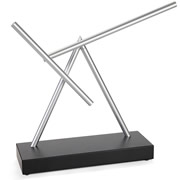
It's that time of year, when I start sending interesting mechanical things your way as gift ideas. Here's a fascinating kinetic sculpture that gives the illusion of perpetual motion.
An 11 inch metal rod pivots from the sculpture's 16 inch support bars. A shorter rod pivots around a fulcrum at the end of the longer one. The two bars silently swing around their respective fulcrums with no obvious source of power to keep them going.
The trick lies in a tiny electromagnet hidden in the base. The magnet causes the end of the longer bar to accelerate which keeps it going for up to a year of continous movement. It may not be perpetual motion, but that's impressive considering it can do this with only four AA batteries!
Check out this awesome new automaton by Marc Horovitz of Sidestreet Bannerworks!
The automaton features an aging robot named Walter. When the crank is turned, Walter bends down to pick up the glasses he seems to have dropped. Sadly, he can't accomplish this task. Having knees certainly would help.
The robot figure is made of tinplate, using techniques found on the outstanding Tinplate Girl website. If you haven't checked it out yet, the site has a wealth of information about how to fabricate cool stuff with thin metal sheets.
Like many of us, Horovitz started making automata after being inspired by the work of Paul Spooner and other automaton makers associated with Cabaret Mechanical Theatre. His mechanisms are compact, elegant, and often elaborate -- not unlike Spooner's. The long cycle, subtle motions, compelling character, and witty storyline show that Horovitz has mastered the craft of contemporary automata making.