Tuesday, March 29, 2016

Clock that physically writes the time created by a Japanese art student

This amazing creation was all over the internet a few weeks ago. I neglected to post about it. I feel that I should do so in case you missed it and because it is possibly the most incredible mechanical device that I have seen anyone make in recent history.

The project, called Plock, was created by art student Suzuki Kango as his senior thesis project. It contains more than 400 wooden parts that control four arms which write out the time on a magnetic drawing pad every minute. The board pushes forward when the time is written, then drops back again. This is a clever way to control the Z-axis. The arms need only be capable of moving in the X and Y axes.

The four large weights suggest that it is weight-driven. There appears to be a balance wheel in the bottom portion, so perhaps that is how it actually tells time. It doesn't seem to be moving at all times however, so this is not clear to me.

The whole thing is made of wood, too! Just astonishing.

There are more images of the writing clock on this web site (text in Japanese).

[ Thanks to Charles and all who suggested I post about this! ]


Labels: , , , , , , , , ,

Wednesday, March 04, 2015

Origami cranes perform synchronized dance routine with the help of magnets

I love this ingenious combination of traditional paper origami, magnets, puppetry, and programmed electronics. The flock of dancing cranes is the creation of Japanese designer Ugoita T. The result is a whimsical whole that is more than the sum of the parts. I think there are a lot of other interesting things he could do with this concept.

Feeling inspired? Here is where you can get all kinds of Origami paper, kits, and instruction books. While your are at it, maybe you'll want some small strong magnets!

Via the Colossal blog


Labels: , , , , , , , ,

Tuesday, May 27, 2014

Ingenius and elegant attempt at creating a perpetual motion machine

The sound of the ball on the track immediately satisfied me that there is friction in this system and thus cannot run indefinitely. Still, it appears to be remarkably efficient and the ingenuity is undeniable. The combination of a metal ball, magnets, a gimbaled rack and multiple pendulums is not something I've ever seen before.

This remarkable piece was made by artist Reidar Finsrud.

[ Thanks Christoph! ]


Labels: , , , , , , , ,

Wednesday, January 02, 2013

Mechanical universal Turing machine uses ball bearings for memory

This charming contraption is described a "mechanical universal Turing machine". According the all-knowing Wikipedia:

A Turing machine is a hypothetical device that manipulates symbols on a strip of tape according to a table of rules. Despite its simplicity, a Turing machine can be adapted to simulate the logic of any computer algorithm, and is particularly useful in explaining the functions of a CPU inside a computer.

Here is a presentation by the maker, Jim MacArthur, describing the background of the machine. I gather the catch with this machine is that you have to assume that the length of track is infinite.

The machine was made mostly out of scrap metal and wood. The components include magnets, springs, cams and levers. It uses ball bearings as its memory. No electrical components were used, other than one small motor used to drive it.

[ Thanks Christoph! ]


Labels: , , , , , , , , , , , , , , ,

Thursday, November 29, 2012

Swinging kinetic sculpture will stay in motion for up to a year

It's that time of year, when I start sending interesting mechanical things your way as gift ideas. Here's a fascinating kinetic sculpture that gives the illusion of perpetual motion.

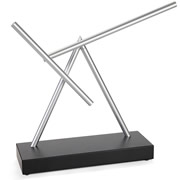
The Perpetual Motion Sculpture.

An 11 inch metal rod pivots from the sculpture's 16 inch support bars. A shorter rod pivots around a fulcrum at the end of the longer one. The two bars silently swing around their respective fulcrums with no obvious source of power to keep them going.

The trick lies in a tiny electromagnet hidden in the base. The magnet causes the end of the longer bar to accelerate which keeps it going for up to a year of continous movement. It may not be perpetual motion, but that's impressive considering it can do this with only four AA batteries!

Here's where you can get what the seller calls The Perpetual Motion Sculpture. Ok, close enough, I suppose.


Labels: , , , , , , , , , , , , , , ,

Tuesday, September 11, 2012

Video shows you exactly how to build a tiny electric motor

I won't need to say much about this video from hilaroad.com that shows how to build a simple electric motor because it is so well-made and comprehensive. The video shows you step-by-step how to go about making a simple battery powered motor. This is a great rainy-day project, party trick, and desktop conversation starter. I've made one myself and the results -- even though entirely expected -- are mysterious and somehow thrilling. You really should try this when you have 20 to 30 minutes (tops!) to spare.

Photo of Simplest Motor Kit
The video also covers the basic theory involved in electromagnetism, which includes the disassembly of a small toy motor. It all makes a lot more sense once you've made a small motor of your own. Other versions of this simple motor have you strip the varnish off the wire on only half of one of the wires. This makes the jump to understanding the commutator a little easier.

If you feel like getting the various materials together would be a hassle, you can always spend a couple of bucks on the Simplest Motor Kit. This would be good option if you want to send one to someone by mail. Though the included explanation book is said to be confusing, if you use it in conjunction with the video shown here, everything should be clear.

Labels: , , , , , , , , , , ,

Friday, February 24, 2012

Levitron Revolution Platform will levitate small objects for display

Photograph of Levitron Revolution Platform

Got a small item you would like to show off in the most futuristic of ways? The Levitron Revolution makes levitating display objects possible! It can hold an object up to 13 ounces in mid-air and illuminates it from below(always dramatic) with 4 white accent LED spotlights. For the added sci-fi effect, the objects continuously revolve in space. Got any ideas? We would love to hear them!

Here is where you can get the Levitron Revolution Platform.


Labels: , , , , ,

Wednesday, December 28, 2011

Electromagnet-driven wooden gear clock

Here's a little video featuring The Electra, another clock designed by Clayton Boyer. Like his other clocks, this one is made almost entirely of wood. What makes it unusual is that rather than being powered by a falling weight, it is driven by a hand-wound electromagnet. There is a shot in the video showing the magnet wire being wound around the core with the aid of a hand drill. Here is a photo showing the ratchet mechanism that moves the time train forward with every full swing of the pendulum:

Electromagnet driven wooden gear clock

You can see more clock designs by Clayton Boyer on his web site.


Labels: , , , , , , ,

Thursday, December 15, 2011

Mechanical gift idea #7 - Not Yet fish automaton

It's not often one has a chance to purchase a genuine automaton by Paul Spooner for 41.5 GBP or about $64 USD. It stands to reason then that it's not often one has the chance to give a gift of a Paul Spooner automaton! Do it.

A bit about this piece from Spooner himself:

Another piece that exploits the attractive/repulsive effects of neodymium magnets. The handle turns a cylinder in which a magnet is inserted radially so that its poles alternate, causing a magnet buried in the fish to feel attracted or repelled by turns. The foil, which is pure tin and beautiful stuff in its own right, stops the fish from becoming airborne.

Clever, beautifully made, and from the workshop of a modern master. You can order Paul Spooner's limited edition automaton Not Yet from the Cabaret Mechanical Theatre web site.


Labels: , , , , ,

Wednesday, May 04, 2011

More magnetic spheres doing unexpected things

Did you see the video of Dave Johnson's magnet machine the other day? He cleverly used magnetic spheres (one brand name is Buckyballs, but there are a bunch of different brands) to do all kinds of nifty moves within a machine. Eventually, I remembered posting about this marble-track toy: the Magnetix I-Coaster. It, too, uses magnetic balls to perform some unexpected maneuvers.

As you can see in the video, the magnetic aspect of the 10mm spheres comes into play at the "magnetic bridge" where the ball clings to a bar above a gap in the track. The ball also is able to roll on the outside face of a downward curve! Also, the Magnetix iCoaster uses the magnets to create an invisible elevator to raise the balls back to the top of the track. I'm not sure, but magnets may also be used for the landing area of the little jump that the ball performs.

When you look at the iCoaster and what Dave Johnson created, you start to get the sense that there are lot of cool things that could be done and the surface has just been scratched.

Here's where you can read a really complete description of the Magnetix iCoaster


Labels: , , , , ,

Monday, May 02, 2011

Buckyball-moving machine by Dave Johnson

Here is a fantastic new kinetic piece by Dave Johnson, which advances spherical rare earth magnets (AKA Buckyballs) around a course using a variety of creative techniques and mechanisms. At one point, he uses the magnets' ability to form a chain to wind them up a dowel. Also, be sure to check out the clever use of the large plastic drywall anchor!

From the YouTube description:

This machine manipulates small spherical rare earth magnets, slicing one at a time from the end of a long chain, moving it around a bit, then dropping it back to re-connect at the tail end of the chain.

It also demonstrates a little snippet of science called eddy currents. Watch how slowly the magnet falls through the aluminum tube compared to falling through air: the falling magnet generates an electrical current in the tube, and that current in turn generates a magnetic field that opposes the movement of the magnet, slowing it down dramatically.

I used a plastic drywall anchor for the main screw drive that pulls the chain of magnets through the machine. The 2 other driven axles -- the slicer and and the lifter -- are geared directly to the screw drive. Steven Garrison's gear cutting method was invaluable to make the gears operate smoothly. The lifter is based on a standard four bar linkage (a film advance mechanism) but was modified to dip very low before lifting back up and stroking its straight vertical line at the top.

Dave Johnson points out that these magnets are currently a popular toy, and can be purchased on the web or in stores -- usually in a set of 216 (for a 6x6x6 cube). There are many different brands: Zen Magnets, Buckyballs, nano dots, NeoCube, and more.

To see more work by Dave Johnson, check out Little Man, Sisyphus Testing Shoes, and Sisyphus in Hiding.


Labels: , , , , , ,

Monday, April 25, 2011

Wood clock driven by hand-wound electromagnet

Yesterday, we took a look at some gears made out of shapes other than circles created by Adrian Iredale. He has been up to some great stuff lately, which includes building this electric clock based on a Clayton Boyer clock design. This is unlike most of the wooden clocks he makes, in that it is powered by electricity rather than a weight or a spring. The project scores huge DIY points for the hand-made electromagnet that is used to drive the pendulum. Check it out in the video! So cool. I am wondering what triggers the magnet to turn on at precisely the right moment, though...

Here is where you can see more wooden clocks designed by Clayton Boyer.


Labels: , , , , ,

Wednesday, March 30, 2011

Hokum automaton by Deane Benninghoven

Here is a lively automaton called Hokum by Deane Benninghoven of Seattle, Washington. The automaton was inspired by the famous Antonio Diavolo, the acrobatic automaton by Robert-Houdin, which featured a figure that was removed at the end of the performance to show it to be free of any linkages.

This piece is made of polymer clay, brass, epoxy, aluminum, pigments, acrylic paint, Plexiglas, Japanese paper, steel, wood, neodymium magnets and features the removable figure.

See more automata and other art by Deane Benninghoven on his web site.

[ Thanks Sharon and Julia! ]


Labels: , , , , ,

Tuesday, March 22, 2011

Bizarre randomly oscillating magnetic pendulum

There is some good fun to be had by combining a simple pendulum with an array of magnets! The Randomly Oscillating Magnetic Pendulum (ROMP) produces some surprising motions as the magnet on the end of the pendulum interacts with the magnetic fields created by the magnets you arrange on the steel base.

Here's a link to the Randomly Oscilating Magnetic Pendulum.


Labels: , , , , , ,

Wednesday, September 01, 2010

BuckyBalls - clever magnetic building spheres

BuckyBalls Magnetic Building Spheres
I wasn't entirely sure if BuckyBalls really qualified as mechanical toys, but a) they are magnets, b) they can be used to construct all kinds of crazy shapes, and c) they're just plain cool.

You can now get them in silver, gold, or black (also in 'original', but I'm not sure how that differs from silver).

They have the full selection of BuckyBalls over at Thinkgeek.com.

[ Thanks Julia! ]


Labels: , , ,

Thursday, August 19, 2010

Interesting 'perpetual motion' type machine


Check out this nifty gizmo invented by Mr. Reidar Finsrud

From the YouTube description:
A steel ball (about 2.7 inch diameter, 20 pound) is rolling on an aluminum track, about 25 inches in diameter, placed horizontally. Three pendulums, about 45 inches long with tunable weights at the lower end, controls three horse-shoe magnets that the steel ball has to pass by on the track. Embedded in the track is a (mechanical) controlling/timing mechanism. It looks like a steel wire bent into a triangular track, 5 inches long. The ball rolls over it and pushes the wire down through a slot in the track. This affects one of the pendulums and regulates its swinging motion. The steel ball has not stopped revolving for months.

Curious? Here is a video showing how this machine might work behind the scenes. Even if this isn't the method used, I want to make one now!
Still curious? Here's a book that deals with the long history of perpetual motion machines, Perpetual Motion: The History of an Obsession

[ Thanks Christophe! ]


Labels: , , , , , ,

Saturday, June 05, 2010

Slinky Science All About Gears, gear-based toy

Slinky Science All About Gears
Learn about the power, drive, and force behind gears with this toy you stick to the fridge or other metal surface.

From the product description:

Motorized magnets & spinning gears! Comes with a 20 page Fun & Fact manual that will lead you through a journey of how gears work!

Here's a link to Slinky Science All About Gears.


Labels: , , ,

Friday, May 14, 2010

Magnetix I-Coaster - marble run toy with magnets

Here's a video advertisement that gives you an idea of what you can do with the Magnetix I-Coaster and some of its unique magnetic features.

From the item description:
Magnetic elevator, 10 towers, 10 tower bases, 11 track pieces, 7 stunt pieces, 17 connector pieces, 2 light-up sensors, plug & play control box with speaker, 5 15-millimeter magnetic metallic rider balls and illustrated instruction booklet.

Here's where you can read a huge description of the Magnetix I-Coaster


Labels: , , , , ,

Tuesday, February 09, 2010

Interesting repelling magnets on spinning wheels

I don't read (or speak) Japanese, but I think what we are looking at in this video are two spoked wheels with magnets on the ends -- each wheel having the opposite pole from the other. Some interesting and unexpected motions result!

Amazon's very cool Industrial & Scientific section has a huge selection of magnets if you are inclined to do some experimenting of your own.

Labels: , , ,

Saturday, December 19, 2009

Levitron - floating top supported by magnets

Levitron cherry wood floating top gizmo
The Levitron top floats in space -- supported only by magnetic waves and the balance imparted by the spinning top. This is the upscale version of the Levitron featuring a cherry wood housing and brass leveling legs. Very nice.

From the product description
Classiest Levitron Anti-Gravity Top - Elegant, wood housing with brass-tone leveling legs. Unique base design amazes onlookers as the high-flying top levitates mysteriously above the opening in the center! Strong magnetic forces hold the top and lifter plate securely in place for easy carrying and storage. A Self-Starter is highly recommended for purchase with Leviton Cherry Wood. Ease in setting the top is essential for not damaging the elegant cherry wood.

Here's the link to the Levitron in cherry wood and brass.


Labels: , , , ,

  |   Older Posts >