Tuesday, January 29, 2013

Spooky Love: A Danse Macabre - automaton book by Thomas Kuntz

Check out this recent work by sculptor and automaton maker, Thomas Kuntz.The beautiful leather-bound book when opened, features a pair of well-dress skeletons dancing under the moonlit sky. The music box movement, made by the renowned Reuge company, was adapted to power the scratch-built cam and lever system that makes the skeletons dance and the moon change size. Some interesting still shots towards the end of the video show some of the artist's in-process shots.

See more automata by Thomas Kuntz on his web site.


Labels: , , , , , , , , , , , , , , ,

Wednesday, January 02, 2013

Mechanical universal Turing machine uses ball bearings for memory

This charming contraption is described a "mechanical universal Turing machine". According the all-knowing Wikipedia:

A Turing machine is a hypothetical device that manipulates symbols on a strip of tape according to a table of rules. Despite its simplicity, a Turing machine can be adapted to simulate the logic of any computer algorithm, and is particularly useful in explaining the functions of a CPU inside a computer.

Here is a presentation by the maker, Jim MacArthur, describing the background of the machine. I gather the catch with this machine is that you have to assume that the length of track is infinite.

The machine was made mostly out of scrap metal and wood. The components include magnets, springs, cams and levers. It uses ball bearings as its memory. No electrical components were used, other than one small motor used to drive it.

[ Thanks Christoph! ]


Labels: , , , , , , , , , , , , , , ,

Thursday, November 29, 2012

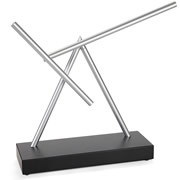
Swinging kinetic sculpture will stay in motion for up to a year

It's that time of year, when I start sending interesting mechanical things your way as gift ideas. Here's a fascinating kinetic sculpture that gives the illusion of perpetual motion.

The Perpetual Motion Sculpture.

An 11 inch metal rod pivots from the sculpture's 16 inch support bars. A shorter rod pivots around a fulcrum at the end of the longer one. The two bars silently swing around their respective fulcrums with no obvious source of power to keep them going.

The trick lies in a tiny electromagnet hidden in the base. The magnet causes the end of the longer bar to accelerate which keeps it going for up to a year of continous movement. It may not be perpetual motion, but that's impressive considering it can do this with only four AA batteries!

Here's where you can get what the seller calls The Perpetual Motion Sculpture. Ok, close enough, I suppose.


Labels: , , , , , , , , , , , , , , ,

Thursday, October 25, 2012

Fluttershy's Bird Choir - a new My Little Pony themed wood automaton

Did you see the My Little Pony wood automaton I posted back in June? Here is the another by the same artist. It is an unexpected sub-genre that is wonderfully incongruous. Whether you agree or not, just look at the craftsmanship!

From the YouTube description:

This third piece in my pony automaton series proved to be the most difficult to design and make by far as I wanted to match Fluttershy's grandiose reputation. Other than the typical moving parts, her bird choir actually sings! The characters, box (stand) and fence are carved out of Philippine mahogany as are the cams, bellows and slide whistle. The gear train and lever arms are made of Narra hardwood. Fluttershy stands at 6"; with the entire display it measures 10 1/4" high, 8 1/2" long, and 4" wide. The entire piece took me a staggering 182 hours to complete.

This very complex and well made automaton is currently for sale on ebay. Check out the pictures and description or just go ahead and buy this one-of-a-kind creation. Here is the eBaby listing for the Fluttershy's Bird Choir wood automaton.


Labels: , , , , , , , , , , ,

Wednesday, October 17, 2012

Upgrade light switches with these clever mechanical add-ons

The father and son team of Lance and L. J. Nybye have come up with a wonderful line of mechanical add-ons for common light-switch covers. The mechanisms are typically cut with a laser from high-quality plywood and finished off with brass hardware. Additional decorations are engraved/burned into the parts with the laser.

From the online shop:

These mechanical light switches transform an ordinary appliance into the perfect flourish for your secret library, steampunk chalet—or wherever your imagination lives!

The mechanical switch covers install easily over a standard switch plate using the existing screws. In addition to the excellent lever-based switch shown in the video, they have a couple of other lovely designs.

Here is their one based on planetary gears...

And another design based on the rack and pinion mechanism...

Here is where you can get these mechanical switch-plate covers.

[ Thanks Jan and Julia! ]


Labels: , , , , , , , , , , , , , , , ,

Thursday, July 19, 2012

Mechanical Devices for the Electronics Experimenter

Mechanical Devices for the Electronics Experimenter

I don't dabble with electronics as much as I used to, but I do on occasion. Just this week I was doing some research and had to find some answers regarding the different types of motors, how to drive them, and how to understand their torque ratings. Mechanical Devices for the Electronics Experimenter came in very handy.

I'm not sure why the ratings on Amazon aren't higher for this book. True, it does not go into great depth on any of the subjects covered, but I suppose that's one reason I like the book. I was able to read up on DC motors, stepper motors, servos, and solenoids in a short amount of time. Of course there must be more to know about these topics, but for a concise summary and review, this book served me well.

And motors aren't the only thing covered. Other chapters include:

  1. Basic mechanical principles - the physics you actually needed to learn!
  2. Sensors - mostly for determining speed and position
  3. Motors and Motor control - with circuit diagrams
  4. Motor control - with some circuit diagrams included
  5. Stepper motors - with info on using cheap surplus motors
  6. Solenoids - including info on making your own
  7. Gears and pulleys - a nice treatment of why the involute form is used
  8. Mechanical components - info on bearings, shafts, springs, ratchets
  9. Pneumatics systems
  10. Vacuum systems
  11. Hydraulic systems
  12. Wheeled vehicles - getting into robot-specific territory here
  13. Arms, legs, and hands - again, mostly of interest to the robot makers

The diagrams are simple line drawings, but they ARE clear. That's what matters. The author likes to throw in a lot of math, but I had no trouble just breezing past it when all I was after were the core concepts. If you happen to like math, well...it's in there. Also, the book makes sure to relate most topics back to electronics. You won't find that in every book.

So the book might be somewhat misnamed. It's really more about the basics of mechanical engineering. With this in mind, I think it's quite a good book. Here is where you can check out Mechanical Devices for the Electronics Experimenter.

If you are searching for something more nut-and-bolts practical, check out Animatronics: Guide to Holiday Displays which has a lot of good nitty-gritty info on the making of mechanical things and Making Things Move DIY Mechanisms for Inventors, Hobbyists, and Artists which is outstanding all around.

If you are in fact looking for in-depth introductory information on mechanical engineering (with even more math), then I recommend Mechanical Engineering Principles by John Bard and Carl Ross.


Labels: , , , , , , , , , , ,

Sunday, July 08, 2012

Mechanical tapping fingers contemplate for you automatically

Think Machine - sculpture of mechanical tapping fingers

Here's another hand-themed mechanical sculpture by artist Chris Eckert -- the man who created the The Waiting Machine I posted about back in 2008. This gorgeous piece is titled Think Machine.

From the sculpture description:

Cranking the handle drives a series of cams and levers making the fingers of the articulated hand tap rhythmically on the mahogany surface - automated contemplation.

See more photos of Think Machine by Chris Eckert on his web site.


Labels: , , , , , , , , , , ,

Tuesday, August 23, 2011

Hero's automatic wine dispensing machine

Hero of Alexandria (aka Heron of Alexandria) created many amazing machines. In addition to his work on pneumatics, he also had a treatise on automata. Shown here is one of the many inventions he is credited with: an automatic wine dispensing machine. Though the narration is not in English, the graphics are so good it hardly matters what language you speak.

Here is the basic idea: A cup at one end of a balance is placed below the spout. A counter weight is removed below the cup and the opposite end of the balance becomes heavier. As the opposite end of the balance descends, it causes a stopper to lift and allow wine to flow out of the vessel and into the empty cup. Eventually, the cup fills with enough wine to tip the balance back to the original position, closing the valve. The weight below the cup is replaced and a pre-measured portion of wine taken away with the cup! Some have argued this is an early form of systems control.

To read more about Hero and other early engineers, the book Ancient Engineers comes highly recommended.

The video is by Omid Ameri.


Labels: , , , , , , ,

Friday, January 14, 2011

Typewriters driven by pin-cylinder-programming

Many automata, looms, music boxes, and other machines use pins protruding from a rolling cylinder to program a sequence of actions. Here's an artistic application of this technique entitled Remember. The large pins on these wooden cylinders activate long wooden arms which type words out on each of several typewriters. Together, the typewriters write a complete sentence...over and over and over...


Labels: , , , , , , ,

Monday, December 27, 2010

Anitique lever-opertated mechanical dice

While obviously an old concept, this is new to me: mechanical dice. Within the stylish faux tortoiseshell box, a mechanism is concealed. By removing the lid you are presented with the faces of two die and a small lever. When the lever is pushed the the dice rotate on discs of some sort. The are stopped using the lever again. I assume it is spring-driven, but maybe the movement of the lever both powers and stops the spinning die wheels. I'm not sure what the advantage is over actual dice, other then being mechanically nifty. Perhaps it is bit more quiet than throwing real dice around. I suppose this was a very early form or automatic random number generator which might have had uses beyond gaming and gambling too.

Here's a link to the full ebay listing with additional pictures of the 19th century mechanical dice.


Labels: , , ,

Tuesday, August 31, 2010

Spirit USA mechanical metal toy

Spirit USA mechanical metal toy
I don't know a lot about it, but here is a nicely retro metal mechanical toy -- part of a new line.

From Glenn Barr's blog:
The prototype by Jamie Mathis is looking fabulous! The soon to be released SPIRIT USA metal/articulated toy will be very chic and mechanically sound... The finish piece will have a nice bronze patina and several working parts.... fun to play with when feeling like you'd like to destroy the world.

Here is where you can see a full sized picture and/or order the Spirit USA metal toy.

[ Thanks deanS! ]

Labels: , , ,

  |   Older Posts >