Tuesday, October 01, 2013

10 Handy Tricks for Woodworkers & Automaton-makers

The latest installment of my column on automaton-making is now live on the Cabaret Mechanical Theatre web site. This one focuses on little tricks that help with automaton-making and woodworking in general. You'll find tips on how to make your own transfer paper and wood filler, some unlikely sources for tools and materials, and a handful of other useful gems. The image above shows a jeweler's ring clamp being used to hold a small piece of brass. This makes filing the piece much easier.

Here is where you can read Dug’s Automata Tips, Techniques and Tricks No. 12 featuring 10 Handy Tricks for Woodworkers & Automaton-makers

I hope at least one of the tips proves useful to you!


Labels: , , , , , , , , ,

Friday, February 08, 2013

Clown Illusionist automaton by Phalibois performs bizarre decapitation routine

Back in December I posted about magician Pierre Mayer's new clown automaton. In the post, I explained that the illusion is a venerable one and made reference to a similar piece by Phalibois. Here is the Phalibois automaton in question.

Like Mayer's piece, this automaton depicts a clown doing a famous decapitation illusion. Because it is a much large piece, it incorporates a music box which also served to drive the mechanism. There are also a few other added surprises in store for the viewer. The automaton was made in Paris by either Henri or Jean Phalibois somewhere between 1890 and 1900. The entire things measures 33-1/2" high by 15-3/4" wide by 19-1/8" deep.

This delightful pieces is located at The Morris Museum, part of the Murtogh D. Guinness Collection of Automatic Musical Instruments & Automata housed there.


Labels: , , , , , , , , , , , ,

Saturday, December 15, 2012

Video of 'The Headless Clown' magic automaton by Pierre Mayer

Image of The Headless Clown automaton

I posted a few days ago about the amazing new automaton by Pierre Mayer. He is known for creating automata that perform a magic trick. This particular piece is a tip of the hat to the famous French maker Phalibois and his headless clown automaton.

As you will see in this new video, the scene starts with clown a holding a fan. The clown slowly raises the fan in front of his face. There is a pause and when the fan is pulled away, the clown's head has disappeared! The top of one of the boxes next to the figure starts to rise, and the clown's head mysteriously emerges from within! The entire sequence then reverses, ending with the clown's head restored to its proper place.

See more magical automata on Pierre Mayer's web site.


Labels: , , , , , , , ,

Thursday, November 29, 2012

Swinging kinetic sculpture will stay in motion for up to a year

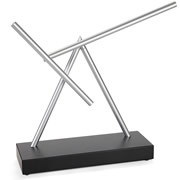
It's that time of year, when I start sending interesting mechanical things your way as gift ideas. Here's a fascinating kinetic sculpture that gives the illusion of perpetual motion.

The Perpetual Motion Sculpture.

An 11 inch metal rod pivots from the sculpture's 16 inch support bars. A shorter rod pivots around a fulcrum at the end of the longer one. The two bars silently swing around their respective fulcrums with no obvious source of power to keep them going.

The trick lies in a tiny electromagnet hidden in the base. The magnet causes the end of the longer bar to accelerate which keeps it going for up to a year of continous movement. It may not be perpetual motion, but that's impressive considering it can do this with only four AA batteries!

Here's where you can get what the seller calls The Perpetual Motion Sculpture. Ok, close enough, I suppose.


Labels: , , , , , , , , , , , , , , ,

Monday, November 26, 2012

Pablo Lavezzari's 'Slot Man' mechanical coin bank sculpture

Here is the latest mechanical creation from the talented Pablo Lavezzari, creator of Facing a Fake Foe and other amazing automata.

image of coin bank sculpture

This time around Lavezzari has created a mechanical bank in the form of a man. Any coin may be placed on the man's outstretched hand. When the lever is pulled, El Tragamonedas (or 'Slot Man') flips the coin into his gaping mouth.

Here is where you can see more about Pablo Lavezzari's Slot Man mechanical coin bank sculpture.


Labels: , , , , , , , , ,

Friday, September 28, 2012

Video of a trick mechanical top hat by Dug North

trick mechanical top

When asked to write and article for my favorite magazine -- MAKE, I jumped at the chance. Editor-in-chief Mark Frauenfelder asked me to document how I made my trick top hat for their first-ever special Halloween issue. The entire issue is dedicated to Halloween DIY projects. The issue is rather awesome. I hope they do another some day.

A hidden mechanism inside the hat is attached to a bicycle brake cable and lever. Run the cable down your sleeve and discretely hold the lever. Any time the brake lever is squeezed, a monster pops out of the top of the hat. Because you can control both the speed and direction of the monster, it has some puppet-like qualities. By raising the monster slowly and only part way, it looks as if he is peeking out tentatively.

The image to the right shows the version that appeared in the magazine. A rubber finger puppet served as the monster until I got around to creating the wooden monster with articulated joints that you see in the video.

Here is where you can get a few more details on this wearable automaton.

P.S. I'll have this one with me at World Maker Faire in NYC on September 29 and 30, 2012


Labels: , , , , , , , , , , , , ,

Monday, August 06, 2012

Rob Ives on working out the locus of a crank

working out the locus of a crank

Rob Ives has a new post on his blog in which he shows a method for experimenting with the locus of a crank-slider mechanism.

A bit of background from Rob Ives's blog:

The locus is the technical name given to the line that a point traces out as it moves. In mechanisms the locus is often not the shape that you would predict. Changes in variables, such as the lengths of the pieces or the position of hinges can make a big difference to the locus.

His experimentation method is simple and ingenious. He uses a few pieces of cardboard, some split pins (the kind that hold papers together), a pencil, and paper. The results are interesting and worth trying for yourself.

Here is where you can read the full article on experimenting with the locus of a crank.


Labels: , , , , , , , ,

Monday, July 23, 2012

Deck of cards shows spinning gears when used as a flip book!

I like the static pattern on the back of these cards. It gets better. When put in order and flipped with your thumb, it shows an animation of gears in motion! Just when I thought these cards couldn't get any cooler, I learned that the pattern also allows them to be used as a marked deck. Wow. I didn't know I could feel this way about playing cards. Give me a moment...

Here is where you can get you own Animated Gears Card Deck


Labels: , , , , , , ,

Saturday, June 23, 2012

How to make wooden joints for puppets, automata, and posable figures

Photograph of a wooden knee joint

My latest column on automata-making is now available on the Cabaret Mechanical Theatre web site. This installment provides step-by-step instructions and plan drawings for making a wooden leg joint. The joint is a little more complicated than some, but it has a few big advantages:

From the article introduction:

To depict a realistic human motion, it is helpful if the figure's joints only bend the way real humans bend. Joints that only move in the correct way give you more options for providing the necessary input motion also. This, in turn, creates a greater range of resulting motions from which to choose.

In the article, you will learn how to create a wooden joint that mimics the motion of a human knee. The joint is suitable for elbows and a few other types of joints as well.

Here's where you can read Dug’s Automata Tips, Techniques and Tricks No. 8 on Creating Wooden Joints for Automata Figures.


Labels: , , , , , , , , , , , ,

Friday, March 16, 2012

How to build the box base for a wood automaton

How to build boxes for wood automata

The seventh article in my Automata Tips, Techniques and Tricks series for Cabaret Mechanical Theatre is now live! In this article, I write about how to make sturdy boxes to hold automaton mechanisms. There are dozens of good ways to make a box. I focus on one simple method using corner butt joints reinforced with wooden dowels. This method is easy to make, doesn't require any special cuts, and can be accomplished with a minimum of tools. Best of all, it allows you to assemble and disassemble the piece during the design and refinement phases of construction. This is a huge time saver!

Here is a link to the article on Building the Boxes for Wood Automata. Also be sure to check out the resources section for some recommended books and tools associated with this article.


Labels: , , , , , , , ,

Wednesday, February 01, 2012

How to use old gift cards to spread glue

The folks at the Timberkits Workshop have taken time to share two uses for old plastic credit or gift cards. It turns out they can be quite useful when gluing Timberkits wood automata kits, or anything else for that matter! The first tip demonstrated shows how to use two credit card shims to allow a captive cam to move freely. The second tip shows that slivers of old credit card make great glue spreaders -- especially for the endgrain of wood.

Timberkits wooden automata kits can be ordered online:
  In the United States visit: http://www.timberkitsus.com/store/
  In the UK and Europe http: xhttp://www.timberkits.com/Home/


Labels: , , , , , , ,

Tuesday, December 20, 2011

21 rotary tool tips and tricks for makers

21 rotary tool tips and tricks for makers

My latest installment of Dug’s Automata Tips, Techniques and Tricks has been published. While past articles have focused on construction methods such as how to make wooden circles or how to make a wooden head, this one takes a look at the power rotary tool, or "Dremel" as we often call it. I offer a number of tips ranging from safety to how to work with materials such as wood, metal, and glass. I also share tricks on getting the most from common accessories. There is a link to a chart that specifies which rotary tool bits work best at which speeds. There is also a link to an interactive bit-finder which helps you select the best tool for the job. I hope you enjoy the article!

Here is a link to Dug North's article on 21 rotary tool tips and tricks for makers of all sorts. Here is where you can find previous installments of Dug's Automata Tips, Techniques and Tricks.


Labels: , , , , , , , ,

Saturday, December 10, 2011

Laetitia, Princess of the air by Pierre Mayer

I've been featuring the work of automaton-maker and magician Pierre Mayer on my blog for a while now. His is the creator of many wonderful magic-trick automata including The Orange Tree, Miniature Orange Tree, The Harlequin, Fechner's Levitation on Stool, a tribute to Siegfried and Roy, and many others.

Here is new and mysterious automaton by Pierre Mayer called "Laetitia".

From the artist's web site:

This automaton differs from the previous one: the Fechner’s levitation. It uses a completely different principle, no magnets this time. Laetitia floats in the air when you turn the handle and the arms raise. A mirror at her back shows there is nothing to hide and creates a perfect illusion for this levitation. Also the flames from the candles twirl and move up.

See more magic automaton by Pierre Mayer on his web site.


Labels: , , , , ,

Friday, October 28, 2011

Automata, magic tricks, posters & books at auction

This clown magician musical automaton was made in Paris by Leopold Lambert around 1910. This is one of several automata and many, many stage magic items to be sold at an auction held by Potter & Potter on Saturday October 29th, 2011.

More about the clown magician:

Impressive clown magician with hand painted face, glass eyes and elaborate costume standing behind a table with a spun metal cup in his right hand and wand in his left. When activated, the magician raises the cup to reveal one of four objects – a watch, a gem, a die, or a compass. The figure performs several actions in order to change the objects under the cup, including raising and lowering his head, shaking head from side-to-side, sticking out tongue, and waving the magic wand in a circular motion. The automaton's actions are accompanied by a two-tune music box.

Here is a link to the auction site, where you can purchase or download the current catalog and bid on items online.


Labels: , , , , , ,

Friday, October 21, 2011

Gyroscope toy: still crazy after all these years

Photo of gyroscope toy

Maybe it's just the soundtrack, but this video from ThinkGeek makes the good old gyroscope toy look pretty entertaining. I've read about them in basic physics books and I have to admit...it still looks like magic to me!

Here a bit from their write up of the toy:
The toy gyroscope hit the market in 1917 and hasn't changed much since your grandparents (or great-grandparents!) played with one. This classic toy fascinates us with its gravity defying stunts, which are easy to learn with a bit of practice. Wind the string, pull it quickly, and the Original Gyroscope will start spinning. Want it to walk a tightrope? Balance on your hand or head? Tilt at impossible angles without falling? You can do it with the power of physics.

Here is the ThinkGeek listing for the Original Gyroscope Toy.


Labels: , , , , , , ,

Wednesday, March 16, 2011

Two methods for making pinwheel gear templates

Two methods for making pinwheel templates
Click your way over to the Cabaret Mechanical Theatre site to read my latest column. In this article I cover two methods for making pinwheel templates on paper. This builds nicely off the last article on methods for making wooden circles.

Here is link to Dug's Automata Tips, Techniques and Tricks No.3: Two Methods for Making Pinwheels Patterns.


Labels: , , , , , , , , ,

Wednesday, March 09, 2011

How to make a surprise pop-out dragon box

A great little mechanical toy is shown in the video above. When you slide the top of the trick box open, a small but nasty little dragon suddenly pops out to tag you.

Here is the full set of instructions with photographs so you can make your own surprise pop-out dragon box.


Labels: , , , , , , ,

  |   Older Posts >