Saturday, March 05, 2016

Musical marble machine created by Martin Molin plays amazing song

Videos of this machine have been all over the internet for the last few days. Many of you and taken the time to write to me to make me aware of it. I thank you all!

The machine, made by Martin Molin, uses an elaborate marble track system to create a sophisticated song. There are some 2000 marbles raised by a tracked elevator which is powered by some vigorous hand cranking. As they descend, the marbles strike the right parts of a glockenspiel, percussion instruments, and bass guitar. A lever system allows the operator/musician to turn selected instruments on and off. This allows the machine to be played in a way that goes beyond simply turning the crank and allowing the programmed track to run.

It's an amazing accomplishment technically and musically. Bravo!


Labels: , , , , , , , , ,

Wednesday, January 28, 2015

Machini the Marvel Performing 'The Study of Levitations' - an automaton by Dug North

I don't get to share my own work on this blog as often as I might like. I just realized that I've had this video for quite a long while, but have neglected to share it with the world.

I designed and fabricated this automaton, once again featuring my character Machini the Marvel! Here he is performing his world-famous act titled The Study of Levitations. When you turn the crank, you will see the magician lift his head and then close his eyes. With a slow wave of his hand, the ink in the inkwell slowly rises, the leather-bound book opens and the pen spins in its holder. As the magician moves his arm back to the starting position, the sequence is reversed.

For more details on this automaton, visit http://www.dugnorth.com/automata_machini_levitation.aspx


Labels: , , , , , , ,

Thursday, October 30, 2014

How to weld a rolling ball sculpture - Part 2: welding a T-joint

Here's artist Tom Harold's second instructional video on how to make welded rolling ball track sculptures. This video covers the basics of welding a T-joint, a commonly used joint in rolling ball sculptures. In the video, Tom shows the proper way to prep parts, tack weld, weld with filler rod, and the details of a track clamp -- one of the special tools he uses in making ball tracks.

See more work by Tom Harold on his web site.

Here's a link to top-rated books on welding. Why stop there? You can buy welders on Amazon -- many with free shipping if you have Amazon Prime, which is well worth it in my experience.


Labels: , , , , , , , , , , ,

Tuesday, September 09, 2014

"Serpina" -- an electromechanical wooden rolling ball clock by Christopher Blasius

Christopher Blasius wrote to let us know about his latest creation: an electromechanical wooden rolling ball clock. Check it out!

From the creator:

I have designed a new clock. Her name is "Serpina" and it's a electromechanical rolling ball clock. Instead of a pendulum, a ball rolls down an inclined plane, which takes 20 seconds. Then the seesaw then tips in the opposite direction and the process begins again.

For more information please visit his website at http://www.holzmechanik.de.


Labels: , , , , , , , ,

Friday, May 23, 2014

Weight-driven rotating marble machine powers a kinetic sculpture

Check out this clever weight-driven kinetic sculpture. The marble moving through the tracks cause the box to rotate, which acts as as type of escapement.

From the creator:

The thread connecting the two weights is wound around a reel on the axis of the front part. As one of the weights is heavier, the front wants to rotate. Where the marble reaches the "bottom", there are two levers. These levers prevent the machine from spinning while the marble is on the track, and release the machine every time the marble hits one of them. The levers also work as a ratchet mechanism to allow easy winding up. The marble probably feels a bit like Sisypho

[ Thanks Felix! ]


Labels: , , , , , , , ,

Tuesday, March 18, 2014

Homemade mechanical rolling ball pendulum clock

Check this thing out! It's a mechanical rolling ball clock made from scratch.

From the video description:

The clock runs for 12 hours, driven by a weight of 2.5 kg sinking approx. 1 meter during that time. Every minute a marble is lifted up and goes down a marble run with three flipping traps that count marbles for minutes, five-minute-steps and hours. The timekeeping element is a second-pendulum with a pinwheel escapement. The clock achieves a drift of less than 1 second per day.

The clock is made of wood, some plastic gears, brass and steel wire, and an old flat iron. Here is where you can see stereoscopic photographs of the clock.

The clock is not unlike the Can You Imagine Time Machine Tabletop Clock. This clock has a battery-operated motor which lifts a steel ball bearing onto a concentric track at regular intervals. The ball then moves with others on a slow downward course, both halted and propelled by see-saws that tip when correctly weighted. The time can be read by observing the numerals that the balls are aligned with - hours and minutes are both indicated.

[ Thanks Christoph! ]


Labels: , , , , ,

Thursday, October 24, 2013

Downloadable plans for action toys at PlayfulPlans.com

Image of wooden toy

Woodworker and author Kevin McGuire has a web site featuring downloadable plans for vintage-inspired wooden playthings. The devious little toy shown in the video above is one of my favorites. On his site will also find plans balance toys, rolling toys, gravity toys, games, and more. His plans include step-by-step instructions, illustrations, and photos of the finished project.

Here is the site's intro video:

Here is where you can check out Kevin McGuire's action toy plans at www.playfulplans.com.


Labels: , , , , , , , , , , , , ,

Tuesday, September 03, 2013

Upcycled! A human-powered tree house elevator made from a bicycle and pulleys!

This human-powered elevator is cool on many levels. First of all, this guy needed an elevator for his tree house! That, in my opinion, is a good problem to have. Secondly, his solution is elegant and fun.

From the video description:

I have built a tree house (though it is not finished yet) that is nearly 30 feet up a tree. I got tired of climbing a ladder six and a half million times a day, so I made a bicycle powered elevator to solve this problem. Don't you wish you had one?

He's counter-weighted the bicycle on the pulley system so less power is required to raise and lower the rider. Next, he has threaded a thin cable that runs around the bike's back wheel and up a tube in front of the rider. When the bike is pedaled in the forward direction, the bike "rides" up the cable. The weight of the rider and bike, keep the back wheel tight against the cable. This means he can also used the hand-brake on the bike's back wheel when descending, as you will see in the video. This is a beautiful bit of engineering and I wouldn't be surprised to see it used elsewhere in the years to come.

Here's a link to a post about the bike elevator on the Colossal blog.

[ Thanks Christoph!]


Labels: , , , , , , , , , , , , ,

Saturday, June 22, 2013

Opportunity - a welded steel rolling-ball sculpture by Tom Harold

Here is a new rolling ball sculpture from artist Tom Harold titled Opportunity. I really like the tone-emitting ball drops!

From the video description:

It measures 52.5" x 33" x 11" and is made entirely of welded steel, clear coated to prevent rust. It features a motor-driven chain lift effortlessly supplying marbles to the topmost track that then divides into two tracks via a tipper-style track splitter. Once on their way, the marbles encounter a number of entertaining devices including a chime, four tone-emitting ball drops, three 360-degree loops, two spirals, wavy track, a four-ball collector, and a coil plus elements made from tubing, welded rings and over 51 feet of track with dips, curves and bends.

To check out additional kinetic art by Tom Harold on his web site or inquire commissioning a piece of fascinating by the artist.


Labels: , , , , , , , , ,

Wednesday, April 24, 2013

Compilation video of a assorted wooden ramp-walker toy designs

Walking rhino toy

We've featured the work of Roberto Lou Ma many times here on The Automata Blog. As you may recall, he designs wooden toys that are able to walk down a slight incline. Some of his designs have free plans, such as the ramp-walking wooden robot and the a ramp-walking wooden rhino toy.

In the video shown here, we get to see the breadth of his creativity within this genre. There are wooden ramp walkers depicting penguins, turkeys, whales, robots, apes, celebrities, elephants, monsters, dinosaurs, and more. A full 5 minutes of gravity-powered wooden toys that show true creativity.

Something that struck me on a few of the figures was the presence of an animated limb -- the troubadour's hand for example. A counterweight on an axis running parallel to the ramp has allowed the figure a secondary motion (strumming the guitar) that adds life and subtlety to the character. It's amazing how so many of them have been designed to capture some essential aspect of how the figure should move -- all within some tight physical constraints. Bravo!

Here is Roberto Lou Ma's YouTube channel, where you can see individual clips of his ramp-walkers and other wooden toys.


Labels: , , , , , , , , , , , ,

Monday, April 15, 2013

The Busted Bricks Marble Machine #2 kit has a wheel elevator and two tracks

Marble Machine #2

A while back, I posted about a new laser-cut marble machine kit from Michael Henriksen, the man behind BustedBricks.com. His second marble machine design is shown in the video. It is is now available as a kit also.

Marble machine #2 is a larger, more complex machine than his first. It has a 150x150mm base and stands 170mm tall. It features a wheel lifter to elevate the 7mm chrome steel balls, which come with the kit. A track switch distributes the balls between the two independent tracks, one of which has a collector that dumps the balls when three have been collected. The lifter wheel is pre-assembled to make sure everything operates as it should.

If you would like to get a good sense for what is involved in making the kit, here is where you can download the assembly instructions.

Here is where you can get the Busted Bricks Marble Machine #2 kit.


Labels: , , , , , , , , , , ,

Tuesday, March 26, 2013

The clatter and whir from the wooden marble machines made by Paul Grundbacher

Image of wooden marble machine

Woodworker Extraordinaire, Matthias Wandel, has a web page on his informative site featuring seven incredible marble machines made by Paul Grundbacher.

According to Grundbacher, a native of Switzerland, he usually skips the other design steps and jumps right into working with wood -- mostly ash, maple, and linden (aka basswood) scraps a from a local factory. Why not? It may not be the most efficient design process, but it's not all about efficiency. Sure, many of his failed experiments may end up going into the fireplace, but he spends his time working in the medium he prefers. I admire that.

Grundbacher makes his own dowels using a technique he learned from his father. That's smart, given how warped and out-of-round some store-bought dowels are.

Here is the page on Matthias Wandel's site about Paul Grundbacher's wooden marble machines.

[ Thanks Walter! ]


Labels: , , , , , , , , , , , , ,

Monday, January 28, 2013

Japanese Autoamta - New book about 18th century Japanese automatic mechanical devices

Cover of Japanese Automata book

There is a wonderful new book out titled Japanese Automata - Karkuri Zui: An Eighteenth Century Japanese Manual of Automatic Mechanical Devices. This book by Kazuo Murakami translates into English the unique book Karakuri Zui, originally published in 1796. The book starts with an introduction which explains the history of karakuri. What follows is a complete translation of Karakuri Zui which explained the mechanisms and methods of construction for several Japanese clocks and mechanical toys of the Edo period in Japan (1603-1867).

Murakami-San wrote to tell me about the Tumbling Acrobot automaton shown in the video above, which I've posted about in the past. He explains that the tumbling doll seems to have already been invented by the beginning of 18th century. Like many of the fine automata of the past, the Tumbling Acrobat was a toy for wealthy people. There is some evidence that the the doll was brought to Europe by the Dutch, where it was then imitated, westernized, improved, and manufactured by German toy makers to look more like this.

The great magician and automaton-maker, Robert-Houdin, bought a tumbling doll from a French toy maker. This story is recounted in the book Two Odd Volumes on Magic and Automata.

All of this information and more is covered in detail in Kazuo Murakami's new book, Japanese Automata. This soft cover book has a total of 257 pages with 104 original diagrams and drawings of the mechanical devices made during the Edo period. It has been published in a limited run of 500 copies.

Here is where you can see sample pages, reviews, and order the book Japanese Autoamta.


Labels: , , , , , , , , , , , , ,

Thursday, January 17, 2013

Wall-mounted wooden marble machine with weight-driven escapement

Image of wooden marble machine

Derek Hugger wrote in to say that he has spent the past few months designing a fully mechanical marble machine. Titled Kinestrata, the assembly is driven by a 2 1/2 pound weight via the classic Graham Escapement -- named for George Graham (1673-1751)an English clockmaker and inventor who is thought to have created it around 1715.

Kinestrata measures 11 x 17 x 5 inches and contains some 386 parts. The balls roll down 4 unique tracks and are lifted back to the top of the machine by 3 geared lifter rings. Hugger says that it took roughly 400 hours to design and build! Plans should be available for it in the next month or two. We'll keep you posted!


Labels: , , , , , , , , , , , ,

Wednesday, January 16, 2013

Charming little rotund wooden elephant ramp walker toy

Image of elephant ramp walker toy

We've seen quite a few wooden ramp walkers, most from the talented and generous Roberto Lou Ma. To change things up a bit, here's one made in Germany. Like other ramp walkers, this one just needs to be placed at the top of a slight incline and given a little push to put it in motion. I love the use of its trunk! The company that sells this little elephant also offers a ramp walking person, hedgehog, and rabbit.

Here is where you can get this wooden elephant ramp walker toy.

[ Thanks Joe! ]


Labels: , , , , , , , ,

Wednesday, December 19, 2012

Hand-cranked miniature ball track kit made from laser cut parts

Photo of miniature ball track kit

Not long ago I posted about a nifty miniature ball track kit. Well, it looks like we might be witnessing the beginning of a trend. The video above shows a different miniature ball track designed by Martin Raynsford, the clever fellow who created the mechanical version of the Donkey Kong arcade game.

The kit allows you to assemble a hand-cranked marble machine. The kit includes all the laser cut wooden parts, the nuts and bolts, and enough balls to fill the machine up and spares (10).

Here is where you can get more details or buy Marble Machine Kit #1.


Labels: , , , , , , , , ,

Friday, December 14, 2012

Wooden Gear Clock uses steel balls within the gears to provided the driving weight.

Check out this amazing wood clock contraption by Steve K. It is a weight driven clock with a very novel way of bringing the weight into play.

From the video description:

This wood gear mantel clock uses steel balls retained in holes in the hour gear to provide the clock drive torque. There are 15 holes and 7 steel balls. Every 4 minutes the lowest ball is ejected from the gear and runs down a track to a lift mechanism that elevates the ball to another track where it is guided into an empty hole in the gear. The lift mechanism is driven by a 3 rpm timing motor hidden in the base.

The clock uses what is known as aGraham escapement coupled to a dumbbell pendulum. The creator says it varies a couple of minutes per day, but doesn't mind because of the ball mechanism. I would feel the same way!

[ Thanks Christoph! ]


Labels: , , , , ,

Friday, December 07, 2012

Unique design of colorful cubes allows you to create marble maze sculptures

MindWare Q-Ba-Maze Marble Run Maze

December is in full swing now, and I had better start making more recommendations for mechanical toy gifts. Here's an interesting one that's come to my attention recently. Basically, it is a toy that allows you to make a customized marble run. The pieces are a bit like LEGOs, so you can easily reconfigure them into any shape your imagination can come up with. This starter set includes 72 cubes in five different colors and 20 steel balls.

From the product description:

Q-Ba-Maze 2.0 is a unique system of colorful cubes that interlock to form a marble run. The big difference? You can create marble maze sculptures in the form of animals, geometric shapes or any other design! Configurations are unlimited, allowing for unpredictable action when steel balls travel the various routes. It's a live demonstration of probability, physics and art, all in one!

So far, the MindWare Q-Ba-Maze Marble Run Starter Set has gotten great reviews by users on Amazon. That's always a good sign! Here is where you can get the MindWare Q-Ba-Maze Marble Run Maze: 72 Piece Set. Here's a page I put together with a assortment of different marble track toys.


Labels: , , , , ,

Thursday, November 29, 2012

Swinging kinetic sculpture will stay in motion for up to a year

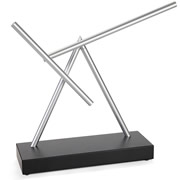
It's that time of year, when I start sending interesting mechanical things your way as gift ideas. Here's a fascinating kinetic sculpture that gives the illusion of perpetual motion.

The Perpetual Motion Sculpture.

An 11 inch metal rod pivots from the sculpture's 16 inch support bars. A shorter rod pivots around a fulcrum at the end of the longer one. The two bars silently swing around their respective fulcrums with no obvious source of power to keep them going.

The trick lies in a tiny electromagnet hidden in the base. The magnet causes the end of the longer bar to accelerate which keeps it going for up to a year of continous movement. It may not be perpetual motion, but that's impressive considering it can do this with only four AA batteries!

Here's where you can get what the seller calls The Perpetual Motion Sculpture. Ok, close enough, I suppose.


Labels: , , , , , , , , , , , , , , ,

Wednesday, November 14, 2012

The Quarterdeck Striker - a hybrid electromechanical wooden clock with moving figure

Unsure of what to do with a wooden nut-cracker figure given to him by his granddaughter, John Hilgenberg created the most interesting clock I've seen in long time. The clock, called The Quarterdeck Striker, behaves like most ship's clocks, striking 1 to 8 bells every half hour in 4 hour cycles.

Image of The Quarterdeck Striker clock

The design is a wonderful mix things: Baltic birch gears, motors, relays, cam operated lever switches, an odometer display, an old coffee table, Geneva wheels, and the nut cracker figure who is put to use striking the bell. The weight driven movement is regulated by a deadbeat escapement and and is rewound with an ingenious maintaining power self-winder of Hilgenberg's own design. Hilgenberg provides a nice overview of the clock in the video.

You can see more clocks and wooden creations by John Hilgenberg on his YouTube channel.

[ Thanks Warren! Thanks Christoph! ]


Labels: , , , , , , , , ,

  |   Older Posts >